
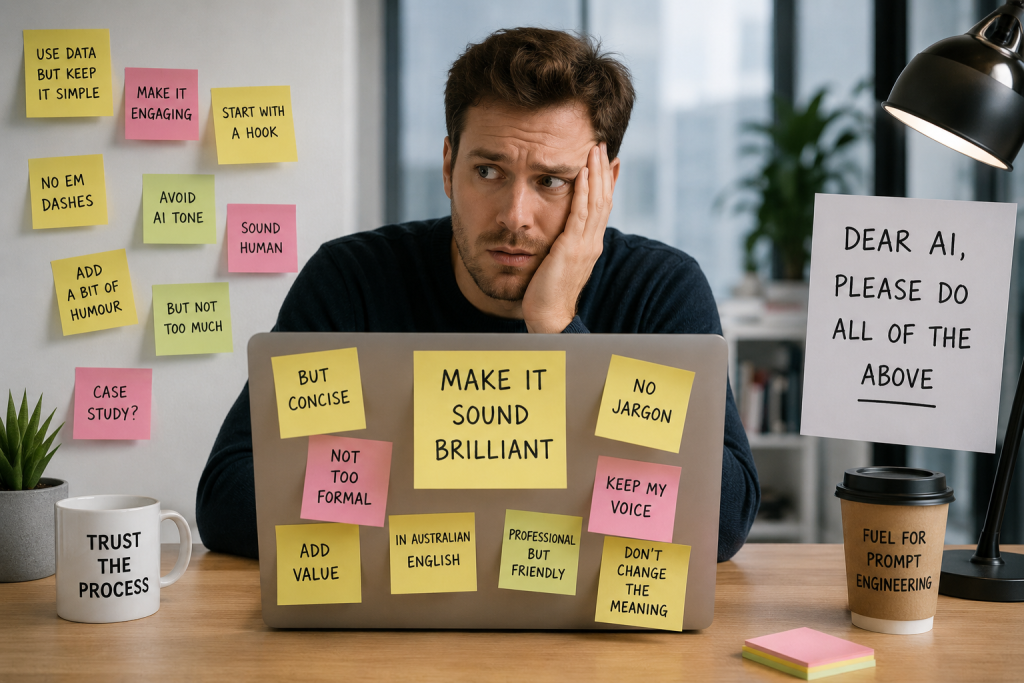
Most organisations experimenting with AI seem to go through the same cycle.
First comes optimism:
“We’ll use AI to save time and improve productivity.”
Then comes confusion:
“Why is the output completely wrong?”
Eventually, someone writes a prompt that sounds less like a request and more like a hostage negotiation:
“Please rewrite this professionally, but not too formal. Keep it concise but detailed. Add personality but remain corporate. Use Australian English. Remove jargon.”
The humour around prompt engineering exists for a reason. AI adoption is rarely just about the technology itself.
AI Is Exposing Existing Workflow Problems
In many organisations, AI is exposing problems that already existed:
- unclear workflows
- inconsistent processes
- poor documentation
- fragmented data
- unrealistic stakeholder expectations
The businesses seeing real value from AI are usually not the ones chasing every new tool. They are the ones improving workflow design, governance, communication and operational maturity.
That matters even more in government, cybersecurity and enterprise ICT environments where accuracy, accountability and defensible decision-making are critical.
The Human Element Still Matters
AI can assist with speed and efficiency, but judgement, context and stakeholder management still rely heavily on people.
As AI adoption grows, organisations are also rethinking workforce capability. Technical skills still matter, but so do:
- adaptability
- critical thinking
- communication
- governance awareness
- the ability to work effectively alongside AI tools
The Future of AI at Work
The future is unlikely to be “AI replacing people.”
More realistically, it will be people who know how to use AI effectively replacing those who do not.
And despite what social media might suggest, there is still no prompt powerful enough to fix a broken process.
PRIMA Recruitment & Consultancy supports government and enterprise organisations across ICT, digital and workforce capability environments where governance and delivery matter.